Most visitors never meet most of this. Florida is a big state and its wildlife changes a lot from region to region - a cane toad is a South Florida backyard problem, a black bear is a central and north Florida one, and a crocodile only matters in the far south. These guides are here for the encounter you do have, not because one is likely.
Giant African land snails are invasive, they can carry rat lungworm, and the state of Florida is actively hunting them – so if your dog finds a huge snail, pull the dog away, do not touch the snail bare-handed, and report it. Most visitors will never see one: the current quarantine areas are in Broward and Pasco counties. If you are staying in or near one of those areas, this page is worth five minutes.
Where they are in Florida right now
Florida has beaten this snail before, more than once. According to the Florida Department of Agriculture and Consumer Services (FDACS), the first detection in 1969 was eradicated by 1975, a Miami-Dade County outbreak detected in 2011 was eradicated by 2021, and a 2022 outbreak in Lee County was declared eradicated in 2026 after more than three years without a live snail.
The job is not finished. FDACS currently lists quarantine areas in Broward County and Pasco County. Inside a quarantine area, moving the snails or “regulated articles” – plants, soil, yard waste, debris, compost and building materials – within, through or out of the zone requires a compliance agreement. If you are renting a house there, that means leave the landscaping where it is. Do not haul yard debris or potted plants home, and do not let the dog dig through mulch piles or compost.
How they get here is usually people. UF/IFAS traces the first Florida outbreak to three snails a Miami child smuggled home from Hawaii in 1966; his grandmother released them into her garden, and within seven years there were more than 18,000. FDACS notes the snails are illegal to import or possess in the United States without a permit.
What they look like, and when they are out
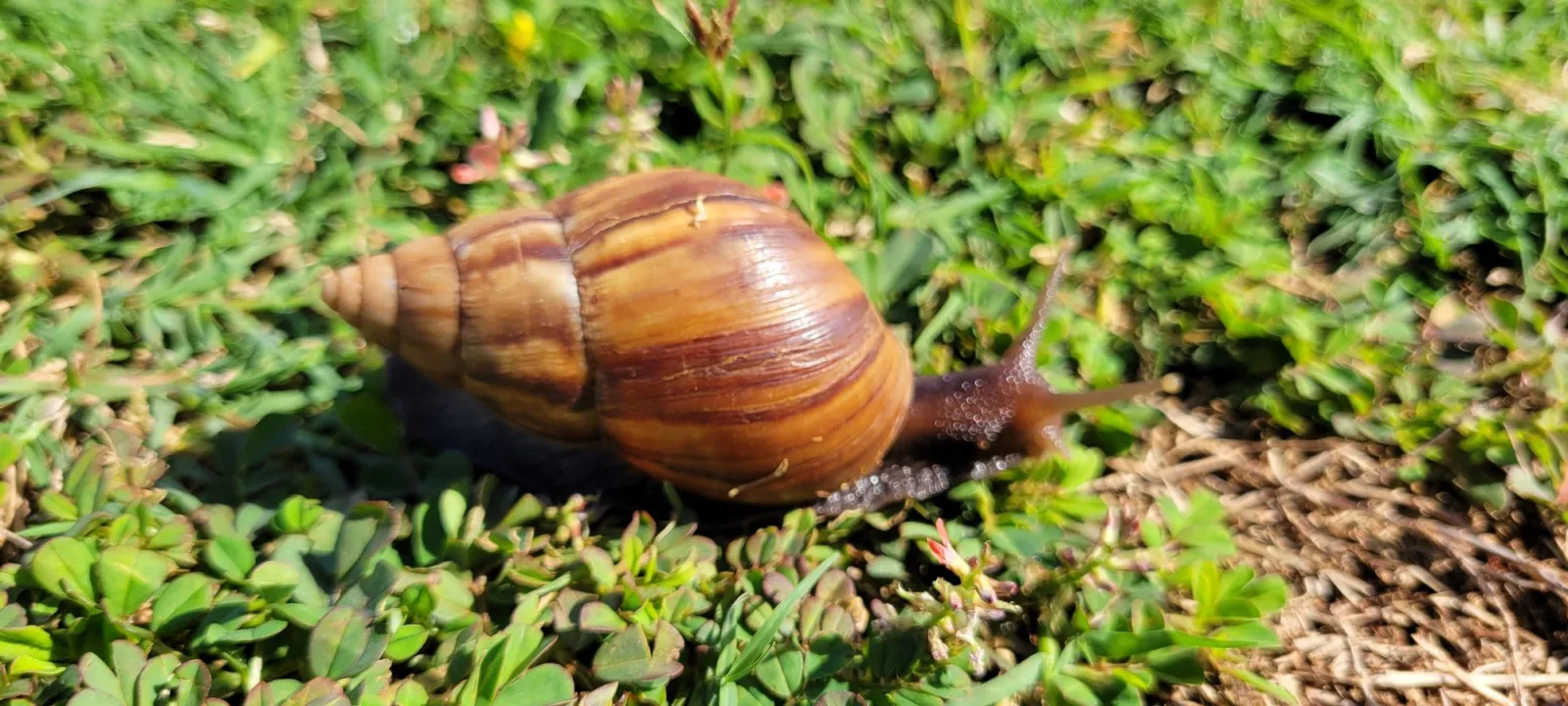
UF/IFAS describes a snail that can reach nearly 8 inches long, with a long conical shell that tapers to a point, typically light brown with dark brown stripes. FDACS says shells range from light to dark brown, and body color varies by population: grayish-brown flesh in the South Florida and Lee County snails, milky white in some Pasco County snails.
They are mostly active at night and during wet weather, and UF/IFAS says one can travel up to 50 feet in a night. That puts them on sidewalks, patios, walls and lawns after rain or irrigation – the same time and place as your dog’s evening walk. In a quarantine area, bring a flashlight and look down.
Florida has native and other nonnative snails, and plenty of large ones get mistaken for this species. Do not rely on a guess, and do not rely on the internet. Take a photo and let FDACS identify it.
Why a dog should never mouth one
The main health concern is rat lungworm, a parasite FDACS says these snails carry and which can cause meningitis in people. That is why FDACS puts its handling rule in capital letters: do not handle snails without wearing gloves. UF/IFAS adds that you can use a tool to pick one up instead, and that the snails can also carry a bacterium that causes illness, especially in people with weakened immune systems.
For dogs, the risk is real but rare. The UF College of Veterinary Medicine notes that dogs elsewhere have been infected with rat lungworm by swallowing an infected snail or slug, that dog cases had not been reported in Florida, and that signs in dogs can include rear-limb weakness and hind-leg paralysis. UF researchers have found the parasite in several Florida counties, in ordinary snails and slugs, rats and even Cuban treefrogs, so the advice applies to every snail and slug, not just the giant ones. Puppies, who explore the world through their mouths, are the ones to watch.
If your dog finds one
- Pull the dog away before it licks, bites or crushes the snail. Do not let it play with the shell either.
- Do not pick the snail up bare-handed. If you must move it, wear gloves or use a tool, and wash your hands afterward anyway.
- Photograph it with something for scale and report it to the FDACS Division of Plant Industry at 1-888-397-1517 or DPIHelpline@FDACS.gov. FDACS asks for photos so it can identify the snail.
- Wipe the dog’s mouth and paws with a damp cloth if it touched the snail or its slime, and wash your own hands.
If your dog or cat ate, crushed or mouthed a suspected giant African land snail, call your vet. Tell them where it happened, whether the area is a quarantine zone and whether the snail was actually eaten. Watch afterward for weakness or wobbliness in the back legs, unusual pain or any change in behavior, and go back to the vet if you see it.
Snail bait can hurt your dog faster than the snail
In quarantine areas, FDACS uses molluscicides including boric acid, iron phosphate and metaldehyde. Homeowners reach for the same products, and this is where dogs actually get hurt. UF/IFAS describes metaldehyde baits as quite toxic to pets and wildlife, and the ASPCA says dogs that eat metaldehyde slug and snail bait can rapidly develop severe tremors and seizures. Both recommend iron-based products as the more pet-friendly option.
If you are renting in a treated area, ask the owner or manager whether bait has been put down, and keep the dog out of beds and borders where pellets might be scattered. If your dog eats snail bait of any kind, call your vet or ASPCA Animal Poison Control at 888-426-4435 (a fee may apply) right away, and have the package in hand. Never scatter your own bait or homemade poison where dogs or cats can reach it.
What to do in a quarantine area
- Keep the dog on a short leash, especially on night walks after rain or sprinklers.
- Carry a flashlight and a pair of disposable gloves.
- Do not move plants, soil, mulch or yard debris out of the area.
- Report suspected snails with a photo instead of collecting them.
- Ask about snail bait at your rental, and call a vet or ASPCA Animal Poison Control if the dog eats any.
A giant African land snail is not something to pick up for a vacation photo. For the bigger story of why Florida keeps collecting invaders like this, see why Florida has so many exotic animals. Quarantine rules cover yard waste and debris, which matters after a storm, so our guide to hurricane debris, floodwater and pets is relevant too. For other things your dog should not put in its mouth here, read about cane toads and dogs and keep our Florida wildlife emergency checklist handy.
Wear this page
Pet Friendly Florida shirts, drawn to match what you just read. This is our own store, not an affiliate link.