
Most visitors never meet most of this. Florida is a big state and its wildlife changes a lot from region to region - a cane toad is a South Florida backyard problem, a black bear is a central and north Florida one, and a crocodile only matters in the far south. These guides are here for the encounter you do have, not because one is likely.
On most of Florida’s coast, beach-nesting birds are breeding from sometime between mid-February and April until September 1, and the exact start depends on the county. A beach can be legally open to dogs while birds are nesting a few hundred feet away, so the rule during those months is short leash, wide berth, and never cross a posted line. Here is the calendar, and what it means on the sand.
FWC shorebird breeding seasons by region
FWC publishes breeding-season windows by county, because nesting starts at different times around the state. Every window currently ends on September 1.
Northwest Florida: February 15 to September 1
Bay, Escambia, Franklin, Gulf, Jefferson, Okaloosa, Santa Rosa, Wakulla and Walton counties. That covers the Pensacola area, the Destin area and Panama City Beach.
North Central Florida: March 1 to September 1
Citrus, Dixie, Duval, Levy, Nassau and Taylor counties, including the coast around Jacksonville and Amelia Island.
Northeast Florida: March 1 to September 1
Brevard, Flagler, Indian River, St. Johns and Volusia counties – St. Augustine, Daytona Beach, Ormond Beach and New Smyrna Beach among them.
Southwest Florida: February 15 to September 1
Charlotte, Hernando, Hillsborough, Lee, Manatee, Pasco, Pinellas and Sarasota counties, which covers Tampa Bay, St. Petersburg, Sarasota and Fort Myers. The exception is Hillsborough’s spoil islands, which run March 1 to September 1.
South Florida: it depends on the county and the habitat
- Collier County: February 15 to September 1.
- Monroe County (the Keys): March 1 to September 1.
- Broward and Miami-Dade counties: April 1 to September 1.
- Martin, Palm Beach and St. Lucie coastal beaches: April 1 to September 1. Their spoil islands and estuaries start earlier, on March 1.
If your trip falls anywhere between February and September, assume some shorebird nesting is happening somewhere on the coast you are visiting.
Which birds, and why they are so easy to hurt
The species at the center of this are small birds that nest directly on open sand. FWC lists four beach-nesters as state-designated Threatened: the American oystercatcher, snowy plover, black skimmer and least tern. Their eggs sit in shallow scrapes and are colored to vanish against the sand, which is great against gulls and terrible against a person or dog who does not know they are there. Wading birds such as herons nest on mangrove island colonies during the same months.
The danger is less about a dog catching a bird than about scaring one. FWC notes that even friendly dogs can be seen as predators, and that one dog passing near a colony of nesting seabirds can cause all the birds to panic and leave their nests exposed to the hot sun. On a Florida beach in May, that does not take long. Flushed adults also leave eggs and chicks open to crows, gulls and trampling. A loose dog, per FWC, can destroy a colony of ground-nesting birds in minutes.
Posted areas and what the rules actually are
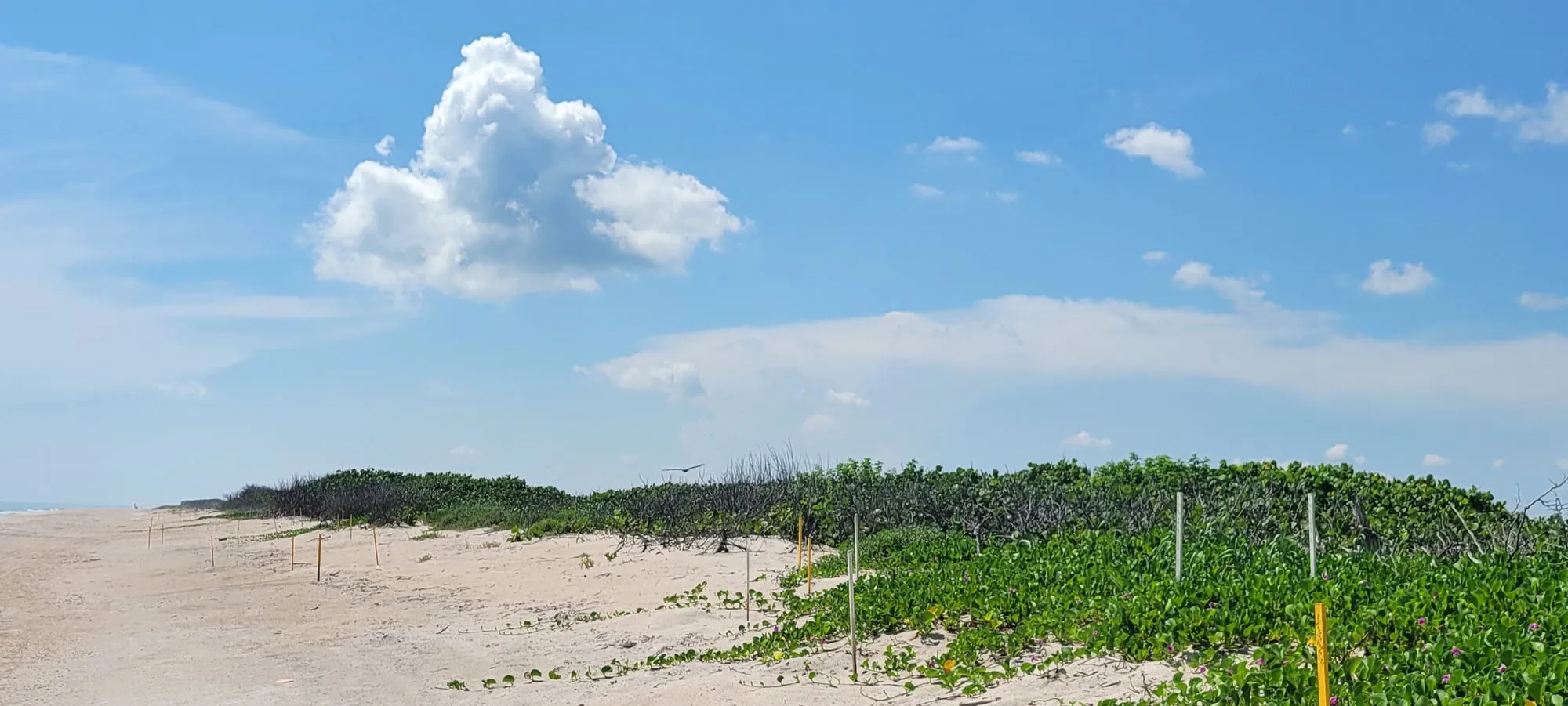
Nesting sites are usually marked with stakes, string or rope, and signs. Treat that line as a wall. Do not step over it, do not walk the dog through it, and do not let the leash reach inside it. Chicks also wander outside posted areas, so the line is a minimum, not a safe zone.
Some of the most important sites are formally designated. Under state rule, dogs, vehicles, vessels and fishing are prohibited within areas posted as “Critical Wildlife Area – Closed to Public Access,” and FWC’s Critical Wildlife Area page explains that each site’s boundaries and closure season are set individually. The four beach-nesters above are also protected under Florida’s Endangered and Threatened Species Rule. Separately, the beach’s own dog rules still apply – nesting season does not open a no-dogs beach, and a dog-friendly beach does not suspend the wildlife rules. Both operate at once. Our pet-friendly beaches guide covers where dogs are allowed in the first place.
How far is far enough
For 2026, FWC’s guidance is to stay at least 300 feet away from nesting birds. Its general bird-viewing advice is more generous, suggesting 500 feet from concentrations of birds. Around a known colony, think in terms of hundreds of feet, not a few leash lengths. FWC’s simplest test works well: when birds are aggravated, you are too close.
Signs you need to back off right now:
- Birds lift off the sand as a group, or a few adults keep circling overhead.
- Adults call repeatedly or dive toward you or the dog.
- Birds run away from you along the sand instead of going back to feeding.
- Adults cluster around small, fuzzy chicks near the dunes or wrack line.
Turn around or swing wide toward the water, and keep the dog on the far side of you.
Fishing, photos and sea turtles in the same season
If you fish the surf with a dog along, set up well away from colonies and resting flocks, do not cast near them, and pick up every scrap of line – monofilament kills waterbirds, and FWC lists line-recycling stations at MRRP.MyFWC.com. For photos, use binoculars or a zoom lens, and do not use the dog’s walk as an excuse to drift closer.
Sea turtles overlap with all of this. FWC puts sea turtle nesting season at March 1 through October 31, so a spring or summer beach trip means watching for both marked turtle nests and bird areas, and keeping beachfront lights off at night. See our sea turtles and dogs guide.
What to do when you get to the beach
- Check the county or city beach page for current dog rules and any posted nesting closures before you go; conditions change week to week.
- Bring a standard six-foot leash, not a retractable. Short and predictable is the goal.
- Walk the firm sand near the water rather than the upper beach and dune edge, where posted nesting areas usually sit.
- Keep the dog from chasing any flock, nesting or not. Migrating shorebirds that winter in Florida need their rest too.
- If you see someone disturbing a posted area, report it to FWC’s Wildlife Alert line at 888-404-3922, or #FWC from a cell phone.
Florida’s nesting calendar is long, but dog-friendly beach trips still work fine through it, as long as the buffers are treated as real boundaries.
Related guides
Wear this page
Pet Friendly Florida shirts, drawn to match what you just read. This is our own store, not an affiliate link.