
Most visitors never meet most of this. Florida is a big state and its wildlife changes a lot from region to region - a cane toad is a South Florida backyard problem, a black bear is a central and north Florida one, and a crocodile only matters in the far south. These guides are here for the encounter you do have, not because one is likely.
The Florida scrub-jay lives nowhere else on Earth, it is federally threatened, and it spends a lot of time on the ground right beside the trail – so on scrub trails, your dog stays on a short leash and on the path, full stop. You do not need to avoid these places. Scrub-jay country is some of the best dog walking in Florida as long as the dog is not the one doing the birdwatching.
A bird that belongs only to Florida
The Florida scrub-jay is the only bird species found exclusively in Florida. The Florida Fish and Wildlife Conservation Commission lists it as federally threatened under the Endangered Species Act, and it is also protected by the Migratory Bird Treaty Act. FWC says its population has declined by about 90 percent over the past century.
It is about the size of a blue jay but looks different: blue head, wings and tail, a pale gray back and belly, a whitish forehead and neck, and no crest and no black markings. If you see a crested jay with black bars on the wings, that is an ordinary blue jay.
What makes scrub-jays memorable is their manner. They are famously bold and curious around people, and may come right up to you on a trail. That is charming for you and very interesting for a dog.
Where you will find scrub-jays and what their habitat looks like
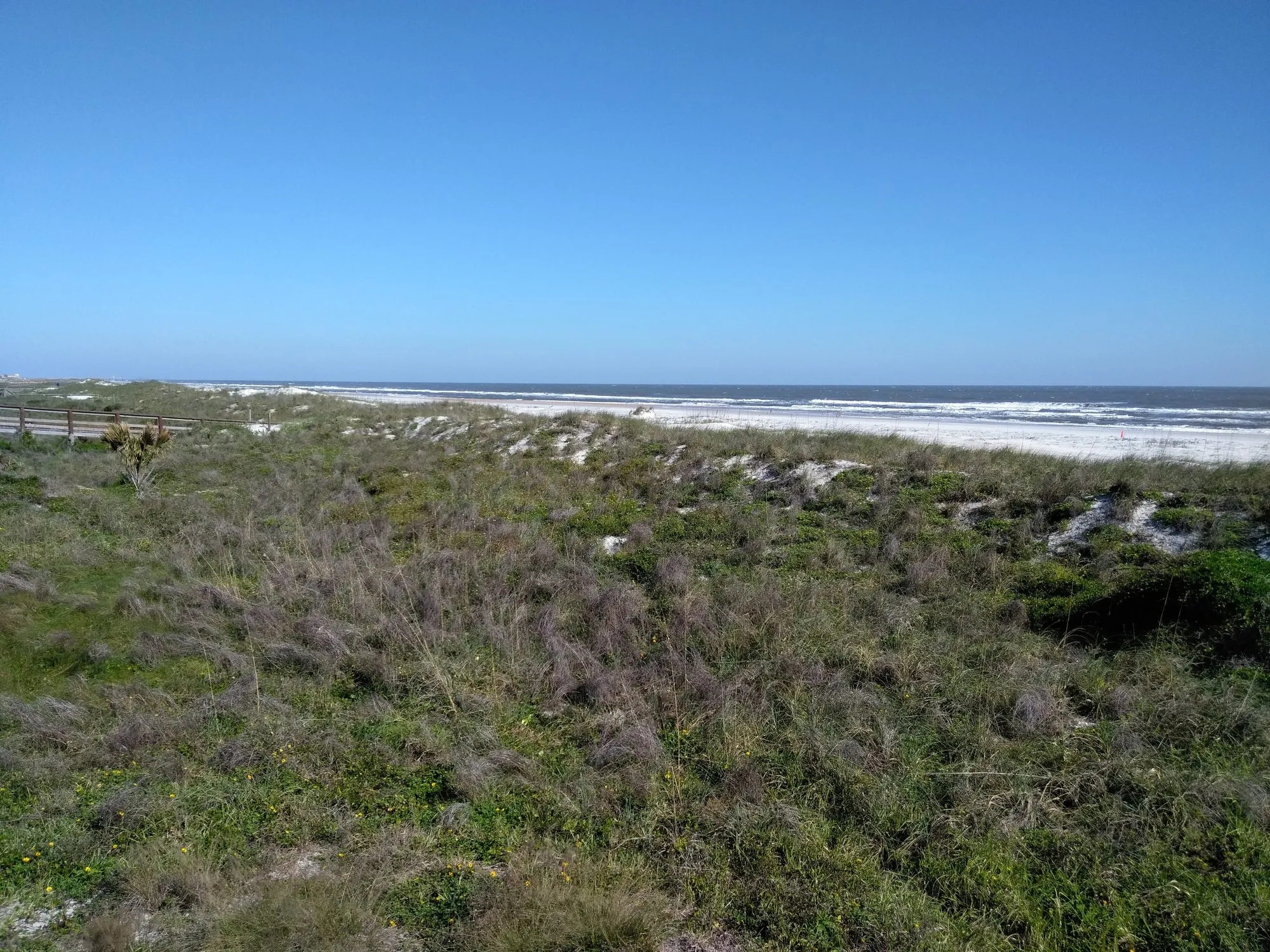
Scrub-jays need Florida scrub, and nothing else will do. FWC describes their habitat as sand pine and xeric oak scrub and scrubby flatwoods on ancient inland sand ridges, old coastal dunes and riverside sand deposits. Picture white sand, low scrubby oaks mostly three to six and a half feet tall, open sandy patches between them, and very little shade. It looks like a desert that wandered into Florida.
This habitat depends on fire. Without periodic burns, the oaks grow tall and the pines close in, and scrub-jays leave. FWC names fire suppression, along with development, agriculture and vehicle strikes, as major threats, and prescribed burning is a core part of managing it. If you walk a scrub trail and see blackened stumps, odds are it was a prescribed burn, done on purpose, partly for the birds.
Two public places where you have a good chance of seeing them:
- Merritt Island National Wildlife Refuge near Titusville, where the U.S. Fish and Wildlife Service says scrub-jays are common all year on the Pine Flatwoods Trail and may be encountered on the Scrub Ridge Trail. Check the refuge’s current pet rules before you go.
- Oscar Scherer State Park in Osprey, south of Sarasota, which protects scrub-jay habitat and has hosted FWC’s Florida scrub-jay festival.
For more options, see our list of the best pet-friendly places to watch wildlife in Florida.
Why dogs and scrub-jays are a bad mix
Scrub-jays forage on the ground and in low shrubs, often close to the trail, and they feed on insects, frogs, toads, lizards, mice, bird eggs and acorns. A dog sees a bird on the ground, close, not flying away. Even on a leash, lunging and barking can break up feeding and drive birds off their territory.
They are also family birds. FWC describes scrub-jays as cooperative breeders that live in groups made up of a breeding pair and young “helpers” from earlier years that stay home to help raise the next brood. Each family holds a territory, and repeated disturbance in that territory matters more for them than for a bird that could simply move down the road.
The same goes for the habitat itself. Scrub is loose sand held in place by slow-growing plants. Off-trail walking, a dog pushing through the shrubs or digging in the sand, and the same disturbance repeated by visitor after visitor all wear it down.
Nesting season: March through June
According to FWC, scrub-jays breed from March through June, usually raising one brood a year. Clutches are two to five eggs, incubation takes about 18 days, and the young leave the nest 12 to 25 days after hatching. Birds usually do not start breeding until they are two or three years old. During this stretch the family is tied tightly to its territory, and adults will call and follow intruders.
If a scrub-jay starts calling repeatedly, trails along behind you or acts agitated, you are probably near a nest or fledglings. Keep walking, keep the dog close, and give the birds more room.
Do not feed them, even when they ask
Scrub-jays are bold enough that visitors are tempted to hand-feed them. Do not. The Florida Museum of Natural History notes that feeding them is a federal offense and is dangerous for young birds, which can die when they are filled up with peanuts and other low-nutrition food instead of the high-protein insects they need. Feeding also gets jays used to people and draws them into developed areas, where cars and cats are major threats – the museum points out that scrub-jays in low scrub are especially vulnerable to cats.
If a scrub-jay lands near you, enjoy the look. Do not reach for it, do not offer food, and do not let the dog jump or lunge. Hold the leash short and let the bird decide how close it wants to be.
What to bring and how to walk a scrub trail
- A six-foot leash, not a retractable. Florida State Parks limits leashes to six feet, and a short leash is the only practical way to keep a dog out of the shrubs.
- Water for both of you. Scrub has almost no shade and the sand reflects heat. Go early in the day, when the sand is cooler on paws.
- Binoculars or a zoom lens. The birds often come to you, but binoculars let you watch a family without stepping off the path.
- Stay on marked trails, and do not let the dog dig, roll or push into the vegetation.
- Keep cats home. If you are staying near scrub, keep cats indoors.
Scrub-jays are a great reason to bring binoculars on a dog walk. For more on walking with a dog in birding spots, see Florida birdwatching with a dog, our list of Florida birds dogs should never chase, and burrowing owls and dogs, another protected bird that lives right at ground level.
Wear this page
Pet Friendly Florida shirts, drawn to match what you just read. This is our own store, not an affiliate link.