
Most visitors never meet most of this. Florida is a big state and its wildlife changes a lot from region to region - a cane toad is a South Florida backyard problem, a black bear is a central and north Florida one, and a crocodile only matters in the far south. These guides are here for the encounter you do have, not because one is likely.
Yes, flamingos in Florida can be genuinely wild. The Florida Fish and Wildlife Conservation Commission treats the American flamingo as a native species, and a growing body of evidence shows that at least some of the birds seen here arrive on their own from elsewhere in the Caribbean. Some individuals may still come from captive flocks, but the old line that “every Florida flamingo is an escapee” is out of date.
Native, gone, and slowly coming back
FWC says American flamingos were native to Florida but disappeared from the state around the turn of the 20th century, when hunting and collecting helped drive them out. After about 1925, captive flamingo colonies started appearing in South Florida, including a breeding colony established at Hialeah Park in the 1930s that still exists. With captive birds in the region, any flamingo spotted in the wild tended to get written off as an escapee, and the idea stuck for decades.
The trouble with that assumption is that American flamingos are strong fliers that travel long distances looking for food and breeding opportunities, and the species lives naturally across the Caribbean and nearby regions. FWC says treating the flamingo as native is not a new determination, and the species is protected under the federal Migratory Bird Treaty Act. That means you cannot capture, harass or keep one, wherever it came from.
Florida’s share is still tiny. FWC puts the global population at roughly 260,000 to 330,000 mature birds and says Florida holds less than one percent of that. A comeback, if that is what this is, is a slow one.
Where flamingos are seen in Florida
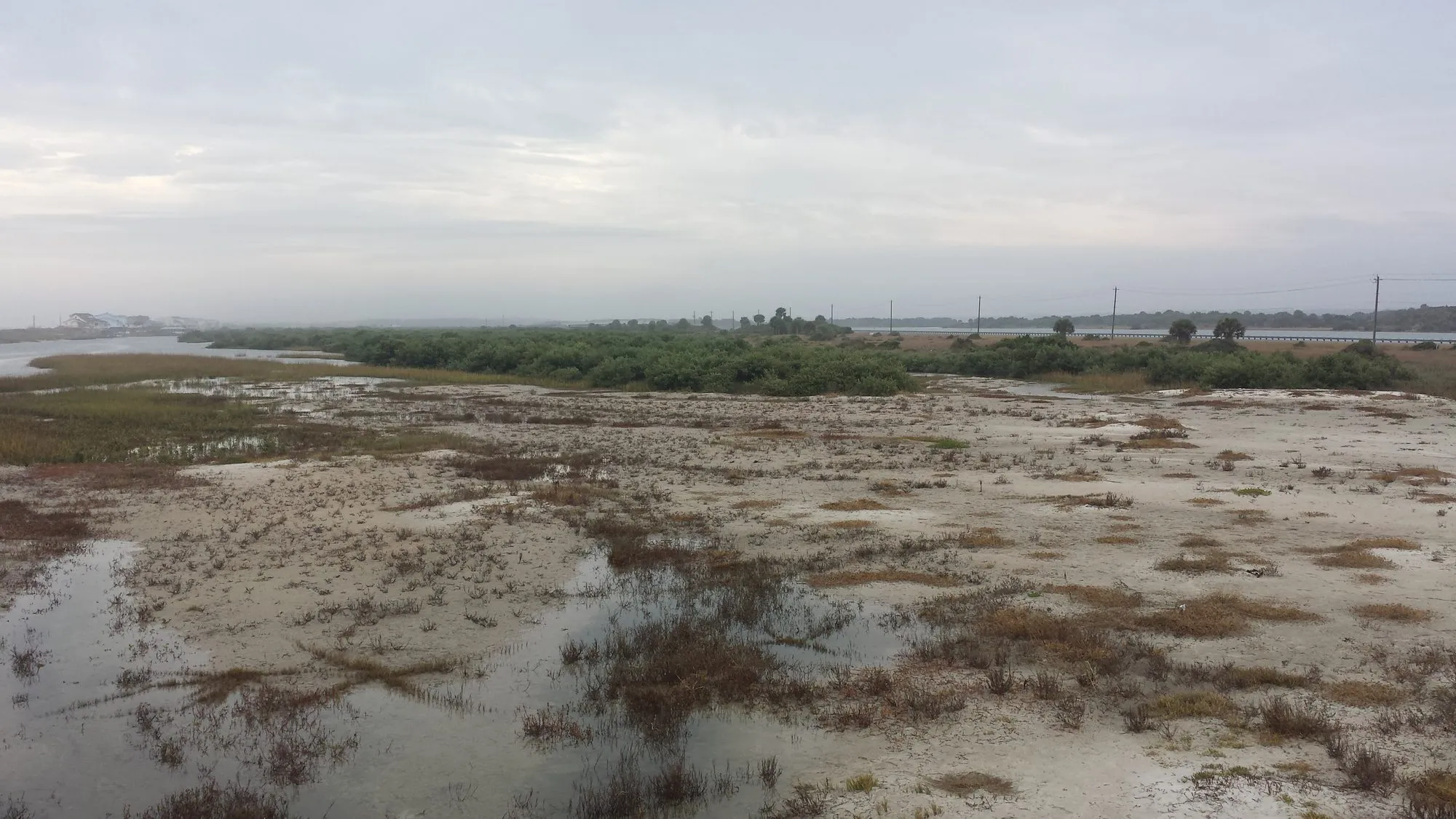
Flamingos have turned up along much of Florida’s coast, but FWC says that outside Hialeah, more than 95 percent of observations have come from three places: the Everglades, Biscayne Bay and the Florida Keys. They are also increasingly reported in the shallow treatment wetlands built along the northern edge of the Everglades. In other words, in Florida this is overwhelmingly a South Florida bird of shallow coastal water and wetlands.
Storms scramble the map. When Hurricane Idalia came ashore in 2023, it carried flamingos from Mexico’s Yucatan across at least 13 U.S. states, as far north as Wisconsin and Ohio, according to the University of Florida. The U.S. Geological Survey’s Bird Banding Laboratory reported that the banded birds among them came from the Yucatan. A flock ended up at Merritt Island National Wildlife Refuge near Titusville in September 2023, which the U.S. Fish and Wildlife Service said was the first flamingo sighting there since 1992. So a flamingo showing up somewhere odd after a hurricane is not automatically a zoo bird.
Flamingo or roseate spoonbill?
Plenty of “flamingos” photographed in Florida turn out to be roseate spoonbills, which are far more common and also pink. They are different birds, and it takes two seconds to tell them apart.
American flamingo
- Very tall – FWC says up to 5 feet – with long, slender legs and a long neck held in an S-curve.
- A thick, down-curved bill with a distinctive black tip.
- Pink to reddish all over, with black flight feathers that show when it flies. The color comes from carotenoid pigments in its food.
- Young birds are white or gray and take up to two years to turn pink, so a pale flamingo is not necessarily a sick one.
Roseate spoonbill
- A long, flat bill with a spoon-shaped tip.
- A white neck and upper back with pink wings and body.
- A bare, bald-looking head and a much shorter neck and legs than a flamingo.
Our guide to roseate spoonbills and dogs covers the more common pink bird in detail.
Watching flamingos with a dog along: the rules that actually apply
Here is the part that surprises people. The best flamingo country in Florida is mostly off-limits to dogs on foot. In Everglades National Park, the National Park Service allows pets only on roads open to traffic, in roadside campgrounds and picnic areas, on maintained grounds around public facilities, and on private boats. Pets are not allowed on any trail – boardwalk, paved or unpaved – on unpaved roads, or on the Shark Valley Tram Road. Leashes can be no longer than six feet, and pets cannot be left unattended.
Florida State Parks also limit leashes to six feet, and most coastal state parks keep pets off beaches and out of the water to protect shorebirds and nesting sea turtles. Rules vary by park, so check before you drive a long way with a dog in the back seat.
The practical answer for most dog owners is to plan the flamingo part of the day as a human-only outing or a view from a spot where pets are allowed, and bring good binoculars or a long lens.
If you do find one, and your dog is with you
- Keep the dog leashed and next to you, and stay well back. A flamingo that stops feeding and starts walking away is telling you that you are too close.
- Do not let the dog into the shallows. Flamingo habitat is also alligator and crocodile habitat in South Florida, and snakes use the same edges.
- Do not walk the dog closer for a better photo. A rare bird can draw a crowd fast, and one dog flushing the bird ruins it for everyone.
- Never feed, chase, try to capture or try to “rescue” a flamingo that looks out of place. If a bird is clearly injured or in distress, report it to FWC or a licensed wildlife rehabilitator and leave it where it is.
- Respect any closures or posted areas set up around rare-bird sightings.
For more on bringing a dog birding, read Florida birdwatching with a dog and our list of the best pet-friendly places to watch wildlife in Florida. If you are curious about Florida’s other colorful and occasionally confusing birds, wild parrots in Florida and why Florida has so many exotic animals are good next reads.
What to pack for a flamingo trip
Binoculars, a zoom lens, a six-foot leash, lots of water and a plan for where the dog waits while you walk a trail. The Everglades and Keys are hot and exposed for most of the year, and a car is never a safe place to leave a dog. If you are traveling with a dog, the smart version of this trip is usually two people taking turns. Flamingos are worth the effort. Just let them keep their distance.
Wear this page
Pet Friendly Florida shirts, drawn to match what you just read. This is our own store, not an affiliate link.