Most visitors never meet most of this. Florida is a big state and its wildlife changes a lot from region to region - a cane toad is a South Florida backyard problem, a black bear is a central and north Florida one, and a crocodile only matters in the far south. These guides are here for the encounter you do have, not because one is likely.
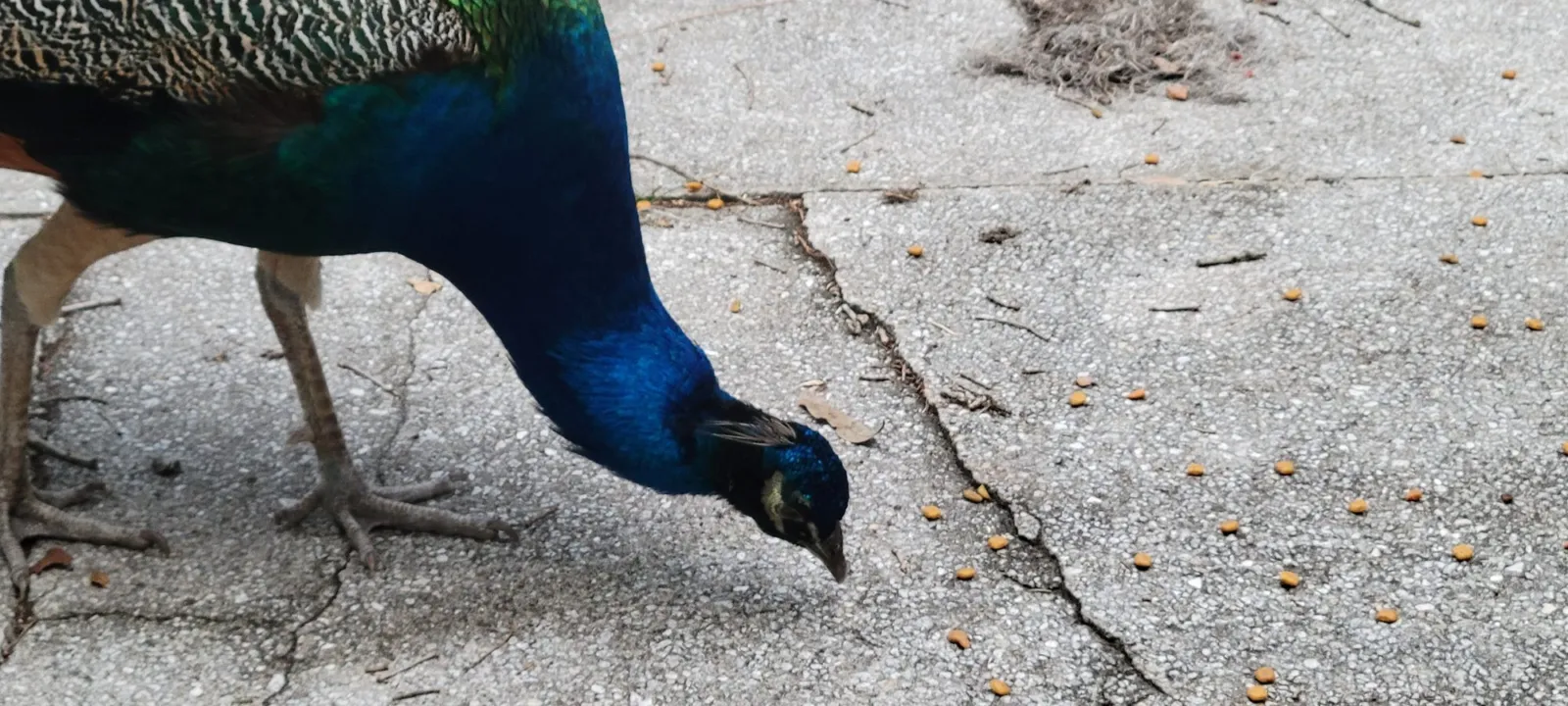
Yes, those are real peacocks strolling down a Florida street, and no, they did not escape this morning. Free-roaming peafowl are established in a number of Florida neighborhoods, where they are treated less like wildlife and more like loud, feathered neighbors. They are not a real threat to a leashed dog, but a cornered adult can hurt one, and a dog that bolts after them can end up in traffic. Short leash, no chasing, and walk around them.
Peacock, peahen, peafowl
Technically, peafowl is the name for the species. The peacock is the male, the one with the long, iridescent train he fans out in display. The peahen is the female, smaller and mostly brown and gray with a green neck. Chicks are peachicks. Most people call all of them peacocks, and so will we when it reads better.
Why Florida has free-roaming peafowl
Peafowl are not native to Florida; the common blue peafowl comes from South Asia. FWC classifies them with chickens and guinea fowl as nonnative domestic fowl that have become established in municipalities around the state after escaping from properties or being released. In some communities the birds have been living on their own for many years and have become part of local identity, while in others they are a regular source of complaints.
That split explains most of what you will see. Some neighborhoods love their peafowl. Others would happily see them gone. Either way, the birds do not care about your dog’s feelings.
Where you may see them
Peafowl populations in Florida are scattered and highly local. You can drive through a dozen suburbs and see none, then turn a corner into a neighborhood where a flock owns the street. They turn up mostly in parts of South and Central Florida, often in older suburban neighborhoods with big trees, and they wander through residential streets, parks, parking lots, golf courses and school grounds. They roost in trees at night, and males call loudly, especially in the breeding season, so a rental in a peafowl neighborhood can come with a dawn alarm clock.
If you are booking a pet-friendly rental and have a dog with strong prey drive, it is worth asking the host whether peafowl live nearby.
We live with one
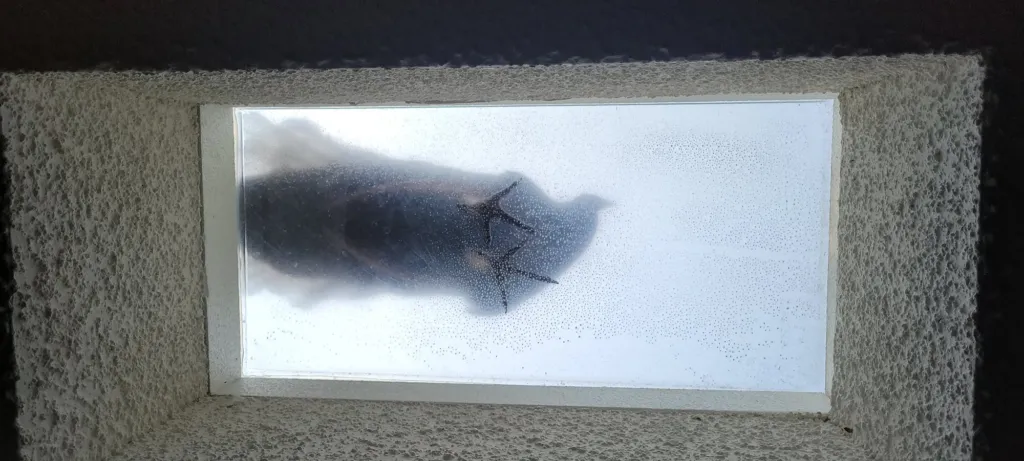
This page is not theory. We have a peacock named Pierre, raised from a baby. Something once attacked him, and he crawled home with a broken wing and a broken leg, then spent his recovery in our chicken coop. He is fully back now, and if the door is left open he walks straight into the house. Most of the peacock photos on this site are Pierre.
Living alongside one teaches you quickly that peafowl are not shy, not quiet and not in any hurry to get out of your way. That is the whole reason a dog needs to be on a short leash around them – the bird will hold its ground far longer than a dog expects.
What a peacock can do to a dog
Peafowl are big birds with strong legs, sharp beaks and spurs on the back of the males’ legs. A bird that has room to leave will almost always walk off, run or fly up onto a roof or into a tree. A bird that is cornered against a fence, or a hen protecting chicks, may fight back with feet and beak, and small dogs in particular can come away with scratches or cuts to the face and eyes.
The more likely injury is the chase itself. Peafowl often cross neighborhood roads slowly, and a dog that lunges after one can pull free and run into traffic.
If your dog does tangle with a peacock, check the face, eyes and ears for scratches or punctures. Take the dog to a vet for any eye injury, deep wound, limping or bleeding that does not stop.
Displaying males and hens with chicks
Males fan and shake their trains in courtship displays and can be more territorial while doing it. Give a displaying male extra room. Peahens nest on the ground and raise chicks in cover, and a hen may defend her young against a curious dog. Keep dogs out of hedges, overgrown lots and other thick vegetation in peafowl neighborhoods, which FWC notes is where the birds shelter and nest.
Rules for peafowl are local
This is the part visitors get wrong in both directions. FWC does not protect peafowl as native wildlife, but it also does not manage them; according to FWC, regulations on possession and removal of domestic fowl fall to individual counties, cities and towns. Property owners and homeowners associations may remove them, or hire a nuisance wildlife trapper to do it, only where local ordinance allows. FWC also notes that releasing nonnative animals is prohibited in Florida.
So do not assume a neighborhood flock is protected, unprotected, or fair game to catch. The answer can differ from one town to the next. If you have a question, the county animal services office or local law enforcement is the right call, not a guess. And whatever the local status, a dog harassing birds in a residential neighborhood is a fast way to get a complaint filed against your rental.
Do not feed them
FWC says peafowl tend to become a nuisance when their numbers grow or when people feed them. Feeding concentrates birds in one spot, encourages them to approach people and pets, and creates conflict with neighbors who are tired of the noise and the damage. FWC lists birds pecking at their reflections in windows and damaging cars among the problems. FWC’s broader guidance on feeding wildlife adds a pet-owner angle: extra food around a house can draw coyotes, bobcats and foxes, which may then go after pets. At a rental, keep pet food and garbage inside, since FWC names pet food as one of the attractants to remove.
A peafowl-safe walk
- Short leash in known peafowl neighborhoods. Retractable leashes give a dog enough line to reach a bird or the road.
- Walk around, not through. Cross the street or wait for the flock to move on rather than squeezing past.
- Do not let the dog corner a bird against a fence, a car or a wall.
- Give displaying males and hens with chicks extra space, and keep the dog out of hedges and brush.
- Watch the road. The bird will stroll into traffic; do not let your dog follow.
- Do not feed peafowl, and do not leave pet food on a porch or lanai.
Peafowl sit alongside Florida’s other famous nonnative residents – see wild parrots in Florida, Florida’s feral parrots, peacocks and monkeys and why Florida has so many exotic animals. For native birds worth looking for on the same walk, our guide to birdwatching with a dog is the next stop.
Wear this page
Pet Friendly Florida shirts, drawn to match what you just read. This is our own store, not an affiliate link.