Most visitors never meet most of this. Florida is a big state and its wildlife changes a lot from region to region - a cane toad is a South Florida backyard problem, a black bear is a central and north Florida one, and a crocodile only matters in the far south. These guides are here for the encounter you do have, not because one is likely.
If you see an alligator while walking your dog in Florida, shorten the leash, get away from the water’s edge and leave by a route that puts more distance between you and the animal. Do not stop for photos and do not let the dog bark, lunge or investigate. Alligators live in all 67 Florida counties, and FWC notes that pets often resemble their natural prey, so the goal is simple: never let the dog become the most interesting thing at the shoreline.
Where dogs meet alligators in Florida
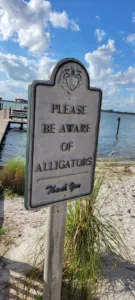
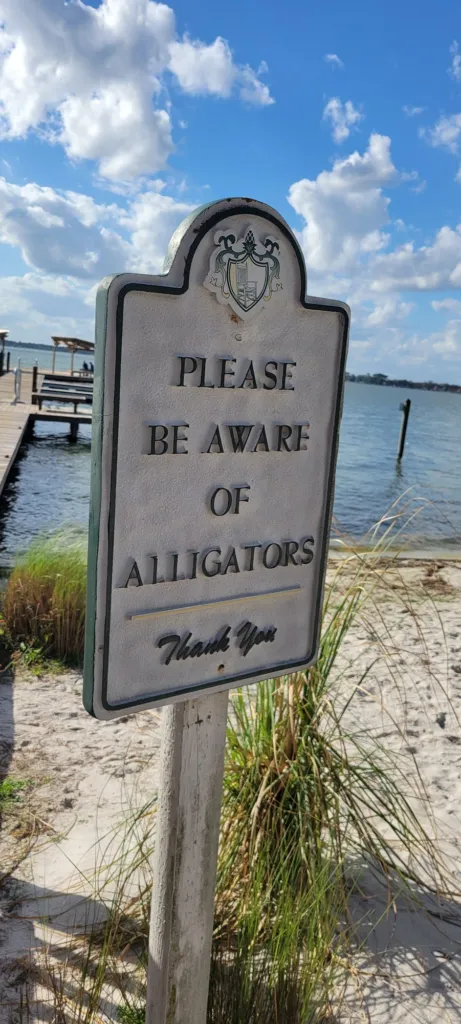
Alligators occur in lakes, ponds, canals, rivers, marshes and brackish water across the whole state, not just the Everglades. For visitors the most overlooked habitat is the retention pond. Treat every Florida retention pond as potential alligator habitat, whether it is small, suburban, next to your hotel or behind an apartment complex. The same goes for golf course water hazards and drainage canals along neighborhood streets.
According to FWC’s safety tips for people and pets, alligators are most active between dusk and dawn. Activity also ramps up in spring: FWC’s alligator facts put the start of courtship in early April, nesting in late June or early July, and hatching from mid-August through early September. That puts the busiest stretch right in Florida’s warm months, when people and dogs are also near water the most.
How to walk a dog near Florida water
FWC’s advice for pet owners is specific, and we follow it to the letter:
- Walk dogs on a non-retractable leash of 6 feet or less, especially at dawn, dusk and night. A retractable leash lets a dog reach the water line before you can react.
- Avoid walking pets along the edge of ponds, lakes, rivers, wetlands or other fresh or brackish water, and do not let them swim there. A lake or canal is not a dog swimming hole.
- Turn on outdoor lights and make some noise before letting the dog out at night, and go out with it, even in a fenced yard.
- Never leave small pets unattended outside if you are staying on the water.
If you want your dog to swim, pick a dog beach or a pool where dogs are allowed. Our Freshwater Fishing With a Dog guide covers how to keep a dog safe on a bank or dock when you are the one near the water.
What to do during an encounter
- Shorten the leash. Bring the dog directly beside you. Do not let it bark toward the alligator, approach it, enter the water or run along the shoreline.
- Back away from the animal and the water’s edge. Distance is the whole strategy. Do not stand around for pictures.
- Leave by a route that adds distance. Never try to pass closely between an alligator and the water, since that is the direction it will want to go.
- If an alligator is on the trail, turn around. Do not try to squeeze past. Give it an escape route and choose another path.
- If an alligator approaches, keep increasing distance, keep the dog quiet and close, and move to a secure area away from the water.
Never let a dog investigate an alligator of any size, a nest or a group of hatchlings. Small alligators are rarely alone, and a nearby adult may be defensive. FWC also points out that handling an alligator, even a small one, is illegal and that alligator bites can cause serious infection.
If an alligator grabs your dog
This is an extreme emergency, and we are not going to pretend there is a technique for it. There is no guaranteed safe physical method for separating a dog from an alligator, and alligator attacks can be fatal to people too. Do not go into the water after the dog. Call 911, and report the animal to FWC.
After any bite or contact, even if the dog breaks free and seems fine, go to an emergency vet immediately. Alligator bites can cause deep punctures, crushing trauma and internal injuries that are not obvious from the outside, and infection is a real risk. Tell the vet it was an alligator bite and roughly how long ago it happened.
The law: feeding, handling and reporting
Feeding alligators is illegal in Florida and dangerous. FWC explains that fed alligators lose their natural wariness and learn to associate people with food, which is how an alligator becomes a nuisance that has to be removed. That includes tossing fish scraps off a dock.
FWC’s Statewide Nuisance Alligator Program handles reports of alligators believed to pose a threat to people, pets or property. The hotline is 866-FWC-GATOR (866-392-4286). FWC generally treats an alligator as a potential nuisance when it is at least 4 feet long and the caller believes it poses a threat, although smaller ones in the wrong place, such as a pool or garage, may also be removed. FWC dispatches a contracted trapper, and nuisance alligators are not relocated because relocated alligators often try to return.
That said, seeing an alligator in normal habitat does not automatically make it a nuisance. An alligator sunning on the bank of a lake is doing exactly what it should. Florida’s goal is coexistence where possible, so report animals that meet the nuisance criteria or are creating a clear threat – one that is approaching people, lingering in a yard or pool, or showing no fear.
A quick routine for water-side stays
If your rental or campsite backs onto a lake, canal or pond, walk the yard with a flashlight before the dog goes out after dark, and fence the pet area where practical. Keep bowls, food and fish scraps indoors. Plan walks away from the water rather than along it, and save long water-side strolls for the middle of the day, when you can see the bank clearly.
For more on living and traveling around alligators, see Alligators and Dogs in Florida, our Florida Wildlife With Pets: Complete Guide, What to Do if Your Dog Is Bitten by a Snake (cottonmouths share much of the same water), and the Florida Wildlife Emergency Checklist for Pet Travelers, which lists what to save in your phone before the trip.
The most important alligator habit for a Florida dog owner is simple: keep the dog farther from the water than you think is necessary.
Wear this page
Pet Friendly Florida shirts, drawn to match what you just read. This is our own store, not an affiliate link.