
Most visitors never meet most of this. Florida is a big state and its wildlife changes a lot from region to region - a cane toad is a South Florida backyard problem, a black bear is a central and north Florida one, and a crocodile only matters in the far south. These guides are here for the encounter you do have, not because one is likely.
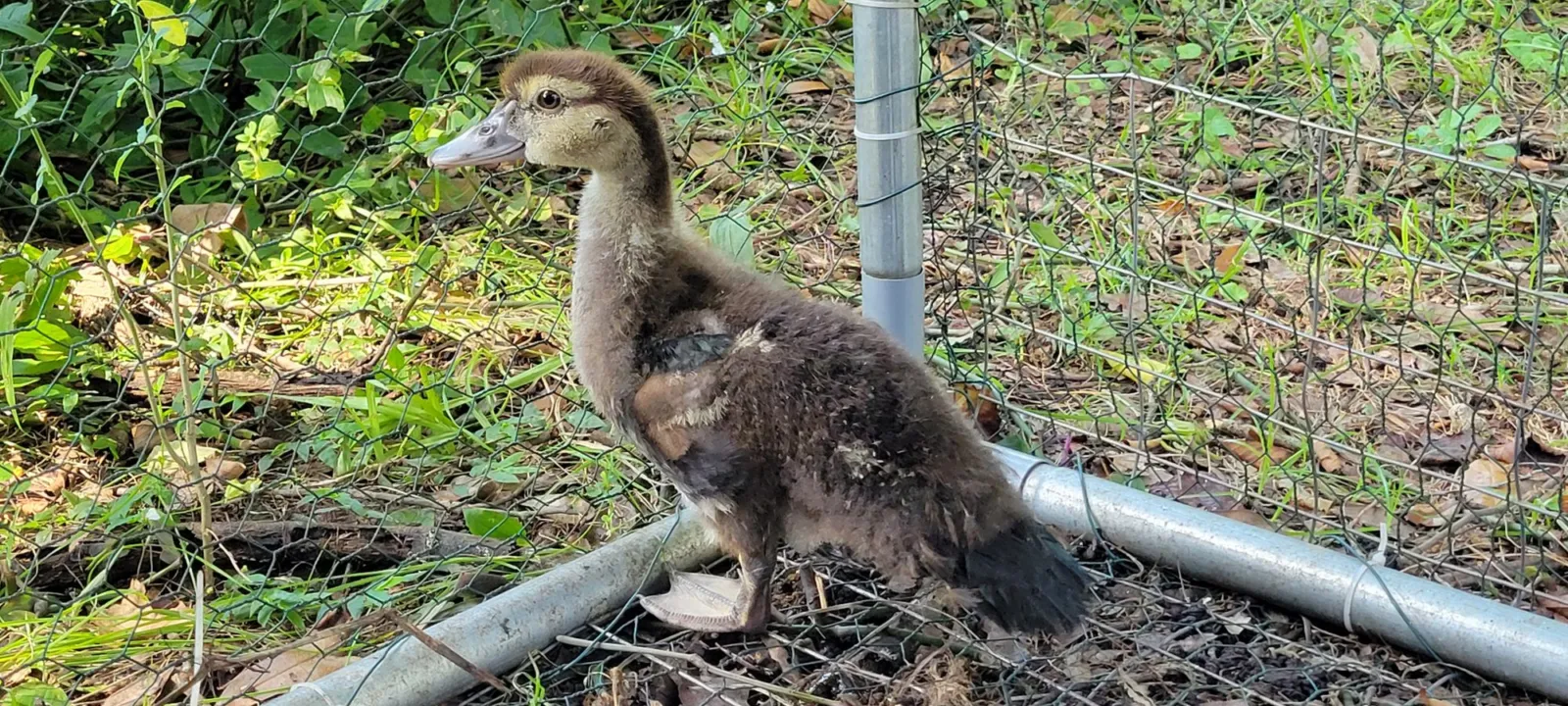
Muscovy ducks are the big, red-faced ducks standing around nearly every retention pond, apartment complex and park lake in urban Florida. They are nonnative and very common, but a dog should still never be allowed to chase, corner or grab one: an adult drake can weigh more than a small dog and fights back with claws and wings, and the pond it runs toward is usually the bigger danger.
How to recognize a Muscovy
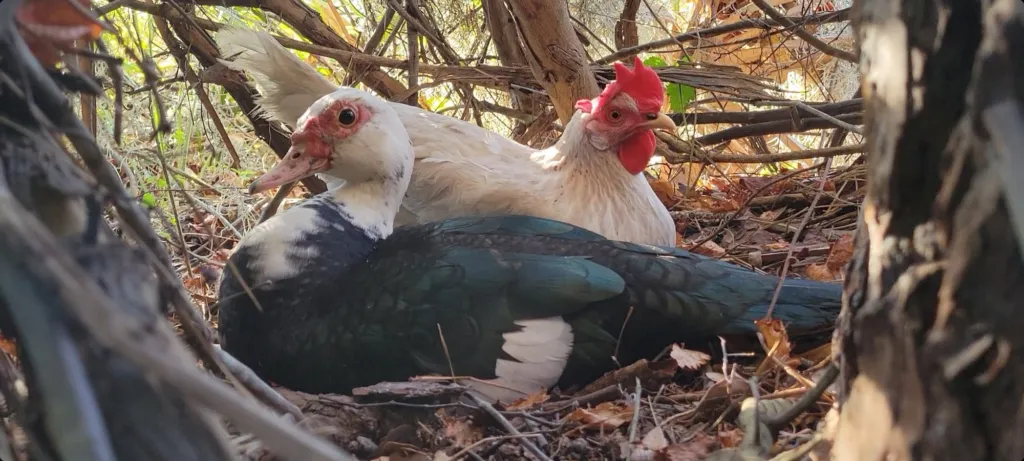
Muscovies look like no other duck in Florida. Males have fleshy red bumps, called caruncles, on the face around the eyes and at the base of the bill; females have smaller caruncles or none. Plumage runs from solid black to solid white to mottled black and white, often with an iridescent sheen. They have long, flat tails and, for a duck, unusually large claws. They also do not quack. According to UF/IFAS, the male’s call is a loud, dry hiss and the female’s a quiet coo, so the hissing duck on the sidewalk is not necessarily angry, just a Muscovy.
They are heavy. UF/IFAS puts males at roughly 10 to 15 pounds, and FWC lists an average around 9 pounds with a wingspan of about 4.5 to 5 feet. That is a lot of bird for a dog to tangle with.
Where you will run into them in Florida
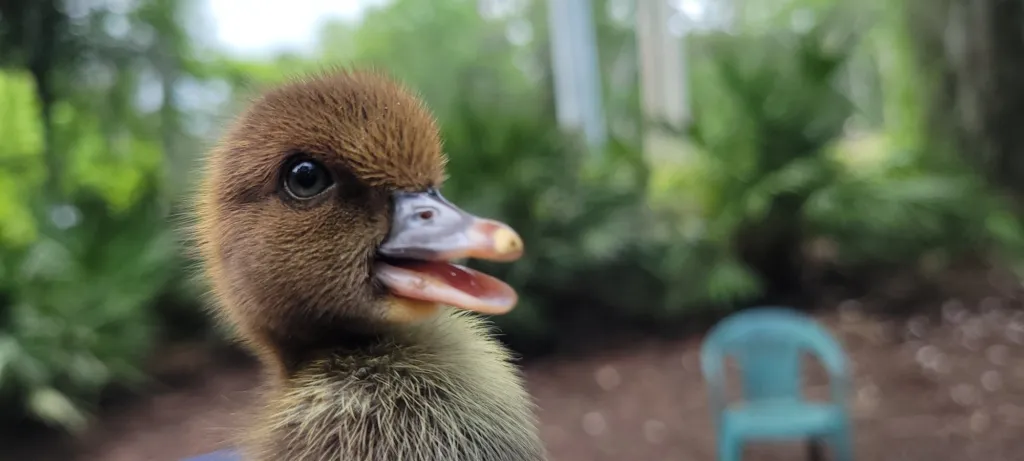
Muscovies are native to Mexico, Central and South America and the southern tip of Texas. In Florida they are feral descendants of released and escaped domestic birds, first recorded here in 1967 and now reported in nearly all 67 counties. FWC notes major populations around Jacksonville, Miami, Fort Lauderdale, West Palm Beach, Fort Myers, Tampa and Orlando.
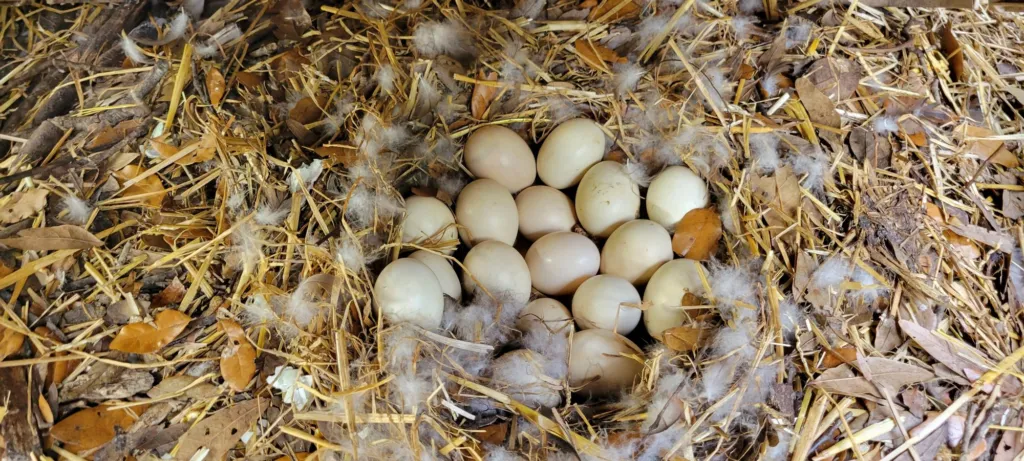
They are a bird of developed Florida rather than wild Florida. Expect them at retention ponds, canal banks, golf courses, apartment and condo complexes, city parks, hotel grounds and parking lots, especially anywhere people feed them. For a visiting dog, that means the morning walk around a vacation rental or a hotel pond is exactly where the encounter happens. Feral Muscovies nest on the ground, often in shallow scrapes in landscaped shrubs and flower beds, and the female lays 8 to 16 eggs and incubates them for about five weeks. A hen tucked into a hedge next to a walkway is easy for a dog’s nose to find before you see her.
What a Muscovy can do to a dog, and what a dog can do to it
Most Muscovies will simply waddle or flap away from a leashed dog. A cornered one, or a hen protecting ducklings, may peck, scratch with those claws and beat hard with its wings. UF/IFAS describes Muscovies as often aggressive, especially birds that are used to being fed, and notes they may chase or try to bite children. A dog that gets its face in close can pick up scratches around the eyes and muzzle; any eye injury, or a scratch or bite that swells, oozes or looks infected over the following days, should be seen by a vet.
The bigger risk is where the chase goes. Ducks run for the water, and a dog in full pursuit follows. Florida retention ponds and canals can hold alligators and snakes, and FWC advises keeping pets away from the water’s edge and out of open fresh water entirely. Our guide to alligators and dogs in Florida explains why ponds that look harmless are not.
There is also the mess. Big flocks leave a lot of droppings, and UF/IFAS warns that the droppings can contaminate water and pose a health hazard to people and pets. That is another good reason not to let a dog drink from, or swim in, a duck pond.
What Florida law says
Because Muscovies are nonnative, the rules differ from those for native ducks. Per FWC:
- No permit is needed to keep Muscovies as personal pets, but exhibiting or selling them requires a Class III wildlife license.
- Releasing Muscovies is illegal under both Florida law and federal regulations. Captured ducks cannot be dropped off at another pond or park.
- They are covered by the federal Migratory Bird Treaty Act, but the U.S. Fish and Wildlife Service has issued a control order that allows landowners to remove them on their own property by lawful, humane methods.
- FWC does not remove nuisance Muscovies. Property owners can handle it themselves under the rules or hire a licensed nuisance wildlife trapper.
None of that makes a dog a legal or sensible removal tool. Do not use your dog to run ducks off a lawn or a dock. UF/IFAS also notes that many cities, particularly in South Florida, have ordinances against feeding ducks.
We come at this from both sides. We raised chickens, ducks and rabbits on a small farm in North Florida, so keeping dogs and poultry apart was part of the daily routine long before it was a paragraph on a website.
Keeping the peace on a walk
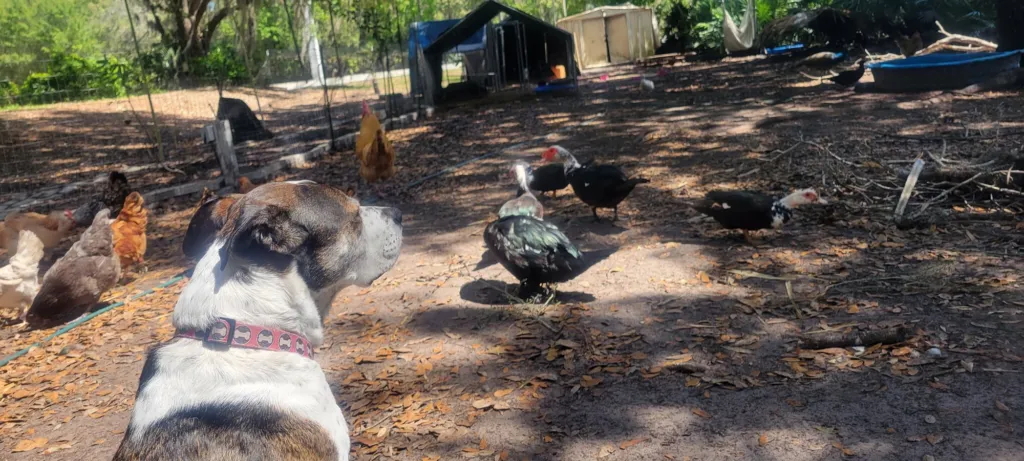
- Short leash near ponds. FWC recommends leashes six feet or shorter, non-retractable, around wildlife. Ducks that suddenly run, flap or fly low set off even calm dogs.
- Walk the outside of the path. Keep yourself between the dog and the water, and give groups of ducks a wide arc.
- Watch the hedges. Slow down near shrubs and flower beds by ponds, where hens may be sitting on nests.
- Give hens with ducklings extra room. Turn around rather than walking a dog through a brood.
- Do not feed the ducks. Feeding draws bigger crowds, more droppings and bolder birds that approach people and pets. UF/IFAS points out that birds that get used to handouts also lose their wariness and end up chased by kids and dogs.
- Bring pet food inside. Dog or cat food left on a patio near a pond feeds ducks, and everything else.
If your dog catches or injures a duck
Get the dog away first; do not reach in with bare hands while a dog and a flapping duck are tangled. Check the dog’s face and eyes, and see a vet for any eye injury, deep scratch or wound that looks infected. For the duck, contact a local animal control agency or wildlife rehabilitator. Response options for injured Muscovies can differ from those for protected native waterfowl because the species is nonnative, so call first before you drive anywhere with a hurt bird.
Short version for the pond walk
Short leash, dog on the side away from the water, no chasing, no feeding, and a wide berth for hens with ducklings and anything hissing from a hedge. Keep pet food indoors. If the dog gets scratched near the eyes or the wound turns red and swollen, see a vet. For more on Florida’s birds and pets, read Florida birds dogs should never chase, Florida birdwatching with a dog, our guide to peacocks in Florida neighborhoods and Florida’s feral parrots, peacocks and monkeys.
Wear this page
Pet Friendly Florida shirts, drawn to match what you just read. This is our own store, not an affiliate link.