Sometimes your dog doesn’t need another attraction.
It needs twenty minutes to run around without you attached to the other end of the leash.
Florida has dog parks everywhere from neighborhood recreation complexes to beachfront parks where dogs can run directly into the ocean.
This guide isn’t meant to list every fenced patch of grass in the state.
It’s a starting point for finding dog parks worth knowing about when you’re traveling around Florida.
Fort De Soto Paw Playground — St. Petersburg Area
Fort De Soto deserves a spot near the top because its dog park comes with something most dog parks don’t:
a dog beach.
Pinellas County provides separate fenced areas for large and small dogs, water stations and access from the dog park to the designated dog beach.
Dogs must remain leashed elsewhere in areas of the park where pets are permitted.
Best For
Dogs that love:
- Swimming
- Running
- Sand
- Longer outdoor outings
This is less like stopping at a neighborhood dog run and more like planning an actual dog activity.
Jupiter Dog Beach — Jupiter
Technically this isn’t a traditional fenced dog park.
It’s better.
Jupiter maintains roughly 2.5 miles of designated dog-friendly beach between crossover #26 and crossover #57. Dogs may be off leash on the designated beach if they remain under effective voice control.
For dogs that prefer running on sand to running around a fenced field, Jupiter is one of Florida’s standout destinations.
Park of the Americas — Orlando
Orlando’s Park of the Americas has separate fenced sections for large and small dogs, along with waste-bag dispensers and trash receptacles.
Dogs are permitted on leash in the remainder of the park.
The broader property also has:
- Walking path
- Shade pavilions
- Picnic tables
- Fitness stations
- Open space
The City of Orlando currently lists park hours as 7:00 a.m. to 9:00 p.m. daily.
Best For
Visitors staying around Orlando who need something more useful for the dog than another day in a hotel room.
Lake Druid Park — Orlando
Another Orlando option is Lake Druid Park.
The city’s park directory identifies a fenced dog run among its amenities.
That gives Orlando travelers multiple municipal options instead of forcing everyone into one crowded park.
Jacksonville Dog Parks
Jacksonville’s public park system has been expanding its dog-park network.
The city’s current list includes:
- Alberts Field
- Springfield Playground
- Ed Austin Regional Park
- Forest Street Dog Park
- John Gorrie/Riverside Park
- Leonard Abess Park
- Oceanway Dog Park
- Tillie K. Fowler Regional Park
Jacksonville states that dogs are allowed in city parks when leashed, with designated dog parks providing off-leash space.
Forest Street Dog Park — Jacksonville
Forest Street deserves special mention because it’s new.
Jacksonville opened the park in 2026 beside Animal Care and Protective Services.
Improvements include:
- Separate large- and small-dog areas
- Double-gated entrances
- Trees for increasing shade
- Picnic tables
- Waste receptacles
- Irrigation
- Landscaping
The city says Forest Street Dog Park opened in spring 2026.
That’s exactly the kind of current information we want PetFriendlyFlorida.com to keep updated.
Alberts Field — Jacksonville
Alberts Field in Mandarin added its dog park in spring 2026 as well.
The surrounding park also has:
- Parking
- Drinking fountain
- Picnic areas
- Restrooms
- Recreation facilities
For travelers staying in southern Jacksonville rather than downtown, it may be significantly more convenient than crossing the city for another dog park.
Treaty Park — St. Augustine
Treaty Park is one of the most useful dog-oriented spaces in St. Augustine.
It gives visitors a dedicated dog park while the larger recreation complex provides trails and other outdoor facilities.
That’s especially valuable because most St. Augustine beach time is still leash time.
After several days of historic-district walking and beach walks, a fenced run can be exactly what a dog needs.
See our dedicated Pet-Friendly Beaches & Parks in St. Augustine guide for more.
Haulover Park — Miami-Dade
Miami-Dade County lists Haulover Park among its free-roaming dog parks.
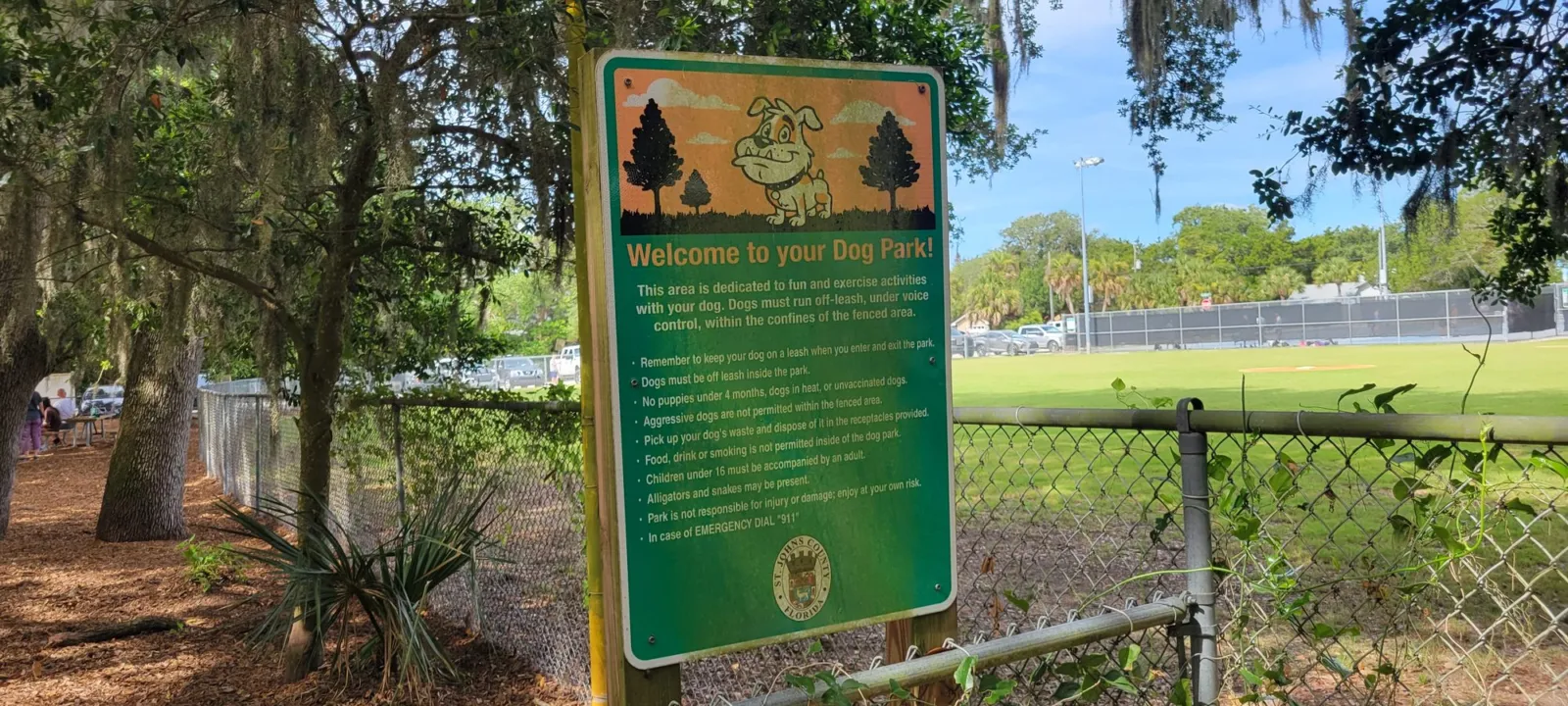
The county’s dog-park rules require:
- Current vaccinations
- Current rabies tag
- Owner supervision
- Leashes until inside the fenced area
- Waste cleanup
- Removal of aggressive dogs
Miami-Dade also restricts puppies under four months from its dog parks.
Haulover is particularly useful because the larger property also has designated dog-beach access.
Amelia Earhart Park — Miami-Dade
Despite the aviation-themed name, this park is in Hialeah.
Miami-Dade includes Amelia Earhart Park among its free-roaming dog-park facilities.
It’s a substantial regional park, making it a better destination for someone looking for a full outdoor outing rather than simply a quick roadside dog run.
Tropical Park — Miami
Tropical Park is another Miami-Dade location with a designated free-roaming dog area.
For visitors staying inland rather than on Miami Beach, county dog parks can be considerably easier to reach than coastal dog-beach areas.
East Greynolds Park — North Miami Beach Area
Miami-Dade operates another dog park at East Greynolds Park near North Miami Beach.
The county specifically identifies the Northeast Regional Dog Park at East Greynolds.
That gives the northern part of the Miami metro another useful off-leash option.
A Good Florida Dog Park Needs Shade
This matters more here than in many states.
A gorgeous grassy dog park with no shade can become nearly useless during a Florida summer afternoon.
When evaluating a park, look for:
- Mature trees
- Shade structures
- Water
- Grass
- Seating
- Separate dog-size areas
- Double gates
For travel, water and shade matter more than fancy agility equipment.
Separate Small- and Large-Dog Areas
These are generally useful.
Even a friendly 80-pound dog can unintentionally hurt a 10-pound dog during rough play.
If your small dog is uncomfortable around larger animals, prioritize parks with dedicated sections.
Fort De Soto, Park of the Americas and Forest Street are among the Florida parks that provide separate spaces.
Check the Ground
Florida dog parks may use:
- Grass
- Sand
- Mulch
- Artificial turf
Each has tradeoffs.
Artificial turf and bare soil can become extremely hot.
Sand can also heat quickly.
If the surface is hot enough to make your dog uncomfortable, leave.
Bring Water Anyway
A park may advertise a water fountain.
It can still be:
- Broken
- Turned off
- Dirty
- Occupied
- Difficult for your dog to use
Carry water and a portable bowl.
Watch the Entrance
Double-gated entries are one of the best dog-park features.
When entering:
- Enter the first gate.
- Close it completely.
- Remove the leash when appropriate.
- Open the second gate.
Don’t open both gates simultaneously.
Dogs are exceptionally good at exploiting the five seconds when humans aren’t paying attention.
Don’t Bring Food Into a Crowded Dog Park
Food can instantly change dog behavior.
Avoid:
- Dog treats
- Human meals
- Chews
- Food bowls
unless park rules and conditions make it clearly safe.
The same goes for favorite toys if your dog guards them.
Vaccinations Matter
Dog parks combine many unfamiliar animals in the same space.
Miami-Dade, for example, requires dogs using its dog parks to be current on vaccinations and display a current rabies tag.
Before traveling, make sure your dog’s preventive veterinary care is current.
Fleas, Ticks and Heartworm
Florida’s climate means parasite prevention deserves special attention.
Talk with your veterinarian about appropriate prevention before traveling.
Do not wait until the dog has spent a week visiting parks around Florida.
Know When to Leave
Your dog doesn’t need to “work it out.”
Leave if you see:
- Escalating aggression
- Repeated bullying
- A dog being cornered
- Resource guarding
- Your dog becoming overwhelmed
- Uncontrolled rough play
A ten-minute visit that ends well is better than staying another twenty minutes until something goes wrong.
Dog Parks Are Not Daycare
Keep watching your dog.
Don’t spend the entire visit:
- On your phone
- Eating lunch
- Talking to someone across the park
Miami-Dade explicitly requires owners to monitor their dogs at all times.
That’s a good rule everywhere.
Best Florida Dog Parks by Type
Best Dog Beach Combination
Fort De Soto
Best Giant Beach Run
Jupiter Dog Beach
Best Orlando Option
Park of the Americas
Best New Jacksonville Option
Forest Street Dog Park
Best St. Augustine Option
Treaty Park
Best Miami Beach-Area Combination
Haulover Park
More Florida Pet Travel
Continue with:
- Best Pet-Friendly Beaches in Florida
- Florida Pet Travel: Heat Safety
- Florida Road Trip Packing List for Dogs
- Pet-Friendly St. Augustine
- Pet-Friendly Jacksonville
- Pet-Friendly Miami
A dog park doesn’t have to become the center of your Florida vacation.
Sometimes twenty good minutes running around is exactly what makes the other twenty-three hours and forty minutes easier.